
 Assistant Professor (Tenure-Track)
School of Computing, the University of Georgia (UGA)
Fei Dou is an Assistant Professor in the School of Computing at the University of Georgia. She obtained her Ph.D. in 2023 from the Department of Computer Science and Engineering at the University of Connecticut, where she worked in the Laboratory of Machine Learning & Health Informatics under the supervision of Prof. Jinbo Bi.
Fei's research is in Machine Learning (ML), with a focus on developing robust, scalable, and context-aware learning methods and AI solutions for real-world human-centered problems. Broadly, she studies how machine learning algorithms can operate effectively in complex environments characterized by noisy, multimodal, heterogeneous, distributed, and context-dependent data. This perspective drives her research at the intersection of machine learning, ubiquitous computing, intelligent sensing, and health AI, where she develops novel learning methods and intelligent systems for real-world applications, such as ambient activity understanding, contactless physiological monitoring, and distributed sensing. Ultimately, across these domains, her goal is to advance machine learning that is both methodologically grounded and practically impactful. Fei's work has appeared in leading venues across AI/ML and ubiquitous computing, including NeurIPS, IJCAI, EMNLP, ICCV Findings, UbiComp/IMWUT, SenSys, PerCom, ISWC, IEEE TMC, and IEEE IoT-J.
Program Committee and Reviewer: NeurIPS, ICML, ICLR, AISTATS; AAAI, IJCAI; CVPR, ECCV; EMNLP; KDD; IMWUT, SenSys, PerCom, CHI, ICDCS; IEEE TMC, IEEE IoT-J.
Join Us: Our lab is seeking highly self-motivated PhD students to explore cutting-edge research in AI, machine learning and intelligent sensing.
Warning
Problem: The current name of your GitHub Pages repository ("Solution: Please consider renaming the repository to "
http://".
However, if the current repository name is intended, you can ignore this message by removing "{% include widgets/debug_repo_name.html %}" in index.html.
Action required
Problem: The current root path of this site is "baseurl ("_config.yml.
Solution: Please set the
baseurl in _config.yml to "Education & Experience
-
 University of Connecticut (UConn)Department of Computer Science and Engineering, Ph.D.
Supervisor: Dr. Jinbo BiSep 2018 - May 2023 -
 Tencent AI LabResearch InternMay. 2018 - Sep. 2018
Honors & Awards
-
Sarah H. Moss Fellowship Award, University of Georgia2025
-
Women of Innovation(WOI) Academic Innovation and Leadership, Connecticut2023
-
Provost Recognition of Teaching Excellence, University of Connecticut2017
News
Selected Publications (view all )
DeepArrhythmia: Segment-Contextualized ECG Arrhythmia Classification via Selective Evidence Acquisition
Jiahui Li, Ruili Fang, Zishuai Liu, WenZhan Song, Jin Lu, Fei Dou# (# corresponding author)
Advances in Neural Information Processing Systems 40 (NeurIPS, CORE A*/CSRankings) 2026
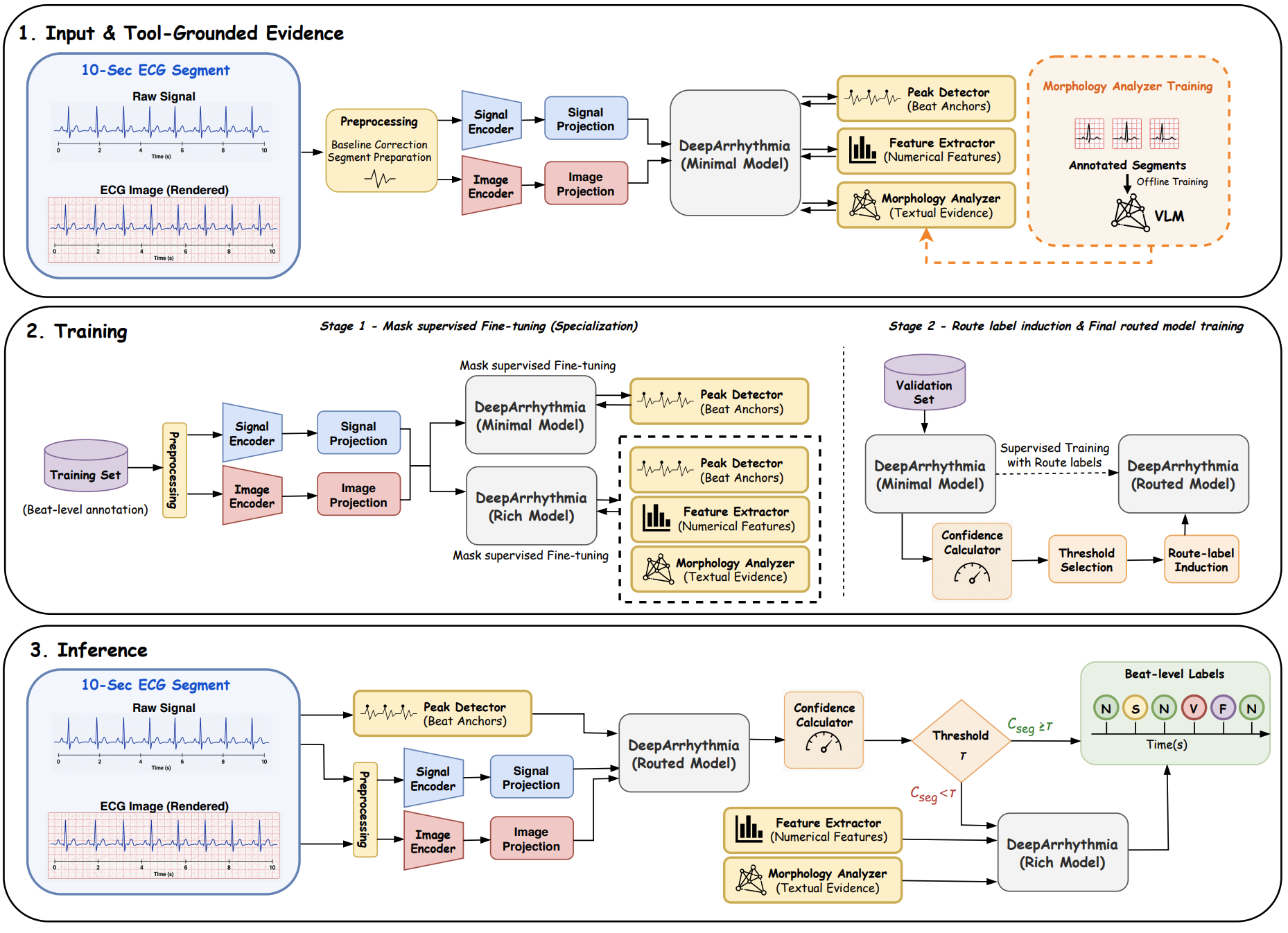
This paper presents DeepArrhythmia, a segment-contextualized framework for beat-level ECG arrhythmia classification. Instead of treating each heartbeat as an isolated instance, DeepArrhythmia leverages multi-beat rhythm context, waveform morphology, and explicit physiological measurements to make beat-level predictions. It combines raw ECG signals, rendered waveform images, R-peak localization, numerical rhythm–morphology features, and morphology-focused textual analysis. By selectively routing between minimal and richer evidence based on segment-level confidence, the framework integrates physiological grounding with adaptive evidence acquisition for more context-aware arrhythmia detection.
DeepArrhythmia: Segment-Contextualized ECG Arrhythmia Classification via Selective Evidence Acquisition
Jiahui Li, Ruili Fang, Zishuai Liu, WenZhan Song, Jin Lu, Fei Dou# (# corresponding author)
Advances in Neural Information Processing Systems 40 (NeurIPS, CORE A*/CSRankings) 2026
This paper presents DeepArrhythmia, a segment-contextualized framework for beat-level ECG arrhythmia classification. Instead of treating each heartbeat as an isolated instance, DeepArrhythmia leverages multi-beat rhythm context, waveform morphology, and explicit physiological measurements to make beat-level predictions. It combines raw ECG signals, rendered waveform images, R-peak localization, numerical rhythm–morphology features, and morphology-focused textual analysis. By selectively routing between minimal and richer evidence based on segment-level confidence, the framework integrates physiological grounding with adaptive evidence acquisition for more context-aware arrhythmia detection.
LastAct: Trajectory-Guided Latest-Activity Localization for Real-Time Smart-Home Activity Recognition
Zishuai Liu*, Ruili Fang*, Jin Lu, Fei Dou# (* equal contribution, # corresponding author)
Proceedings of the ACM on Interactive, Mobile, Wearable and Ubiquitous Technologies (UbiComp/IMWUT, CSRankings) 2026
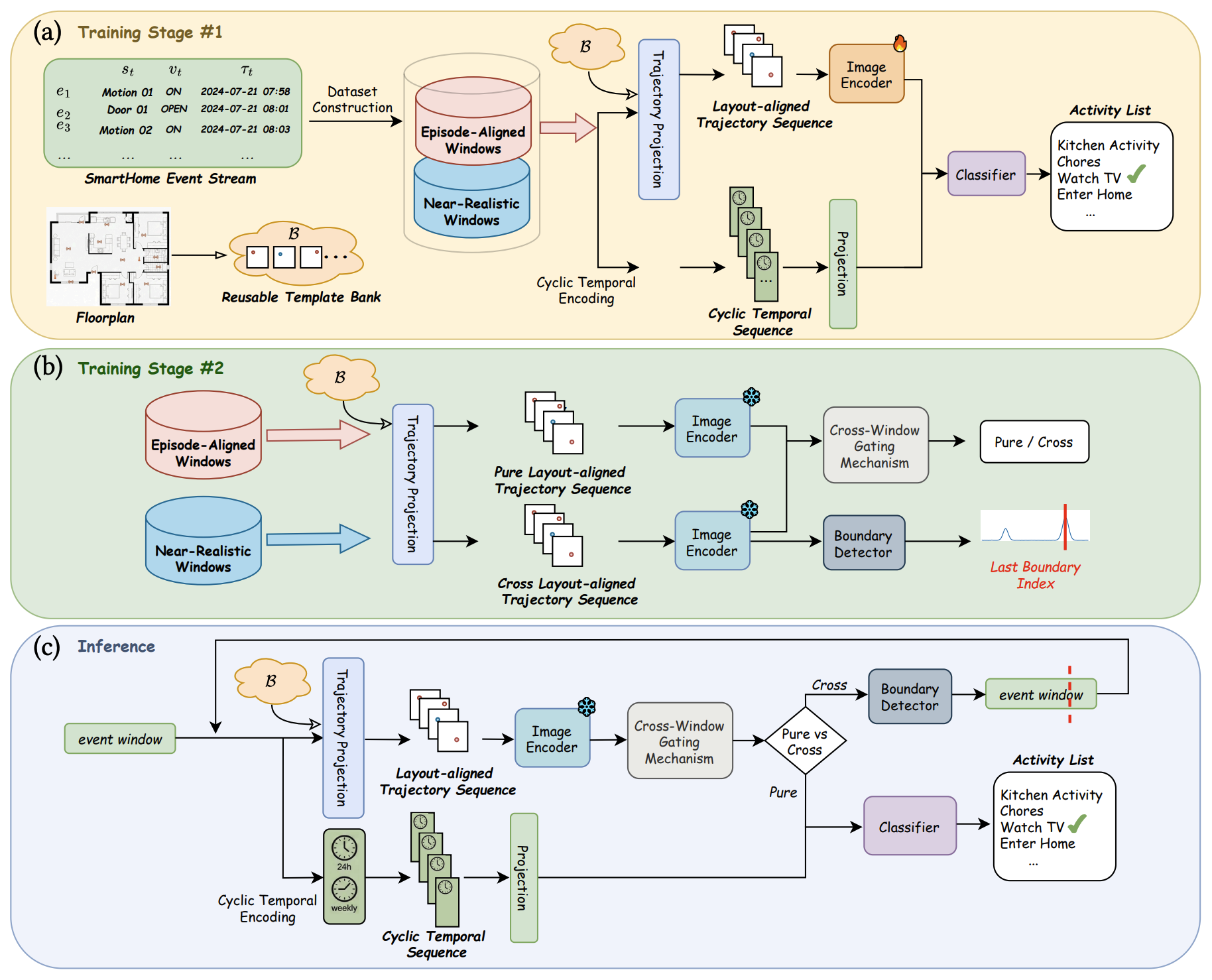
This paper presents LastAct, a trajectory-centric framework for streaming smart-home human activity recognition under realistic mixed-window settings. Instead of assuming pre-segmented activities, LastAct targets the most recent activity in continuous sensor streams where activity boundaries are unknown. It maps ambient sensor events onto home floorplans to preserve spatial trajectories, detects contaminated windows, localizes the latest activity transition, and masks stale pre-boundary evidence. Across four public smart-home datasets, LastAct improves robustness on mixed-activity windows while maintaining competitive performance on pure windows.
LastAct: Trajectory-Guided Latest-Activity Localization for Real-Time Smart-Home Activity Recognition
Zishuai Liu*, Ruili Fang*, Jin Lu, Fei Dou# (* equal contribution, # corresponding author)
Proceedings of the ACM on Interactive, Mobile, Wearable and Ubiquitous Technologies (UbiComp/IMWUT, CSRankings) 2026
This paper presents LastAct, a trajectory-centric framework for streaming smart-home human activity recognition under realistic mixed-window settings. Instead of assuming pre-segmented activities, LastAct targets the most recent activity in continuous sensor streams where activity boundaries are unknown. It maps ambient sensor events onto home floorplans to preserve spatial trajectories, detects contaminated windows, localizes the latest activity transition, and masks stale pre-boundary evidence. Across four public smart-home datasets, LastAct improves robustness on mixed-activity windows while maintaining competitive performance on pure windows.
Peak-Detector: Explainable Peak Detection via Instruction–Tuned Large Language Models in Cardiac Physiological Signal
Jiahui Li, Yida Zhang, Zixuan Zeng, Jiayu Chen, Yingjian Song, Yin Xiao, Nishan Dong, Junjie Lu, Younghoon Kwon, Xiang Zhang, Jin Lu, WenZhan Song, Fei Dou# (# corresponding author)
Proceedings of the ACM on Interactive, Mobile, Wearable and Ubiquitous Technologies (UbiComp/IMWUT, CSRankings) 2026
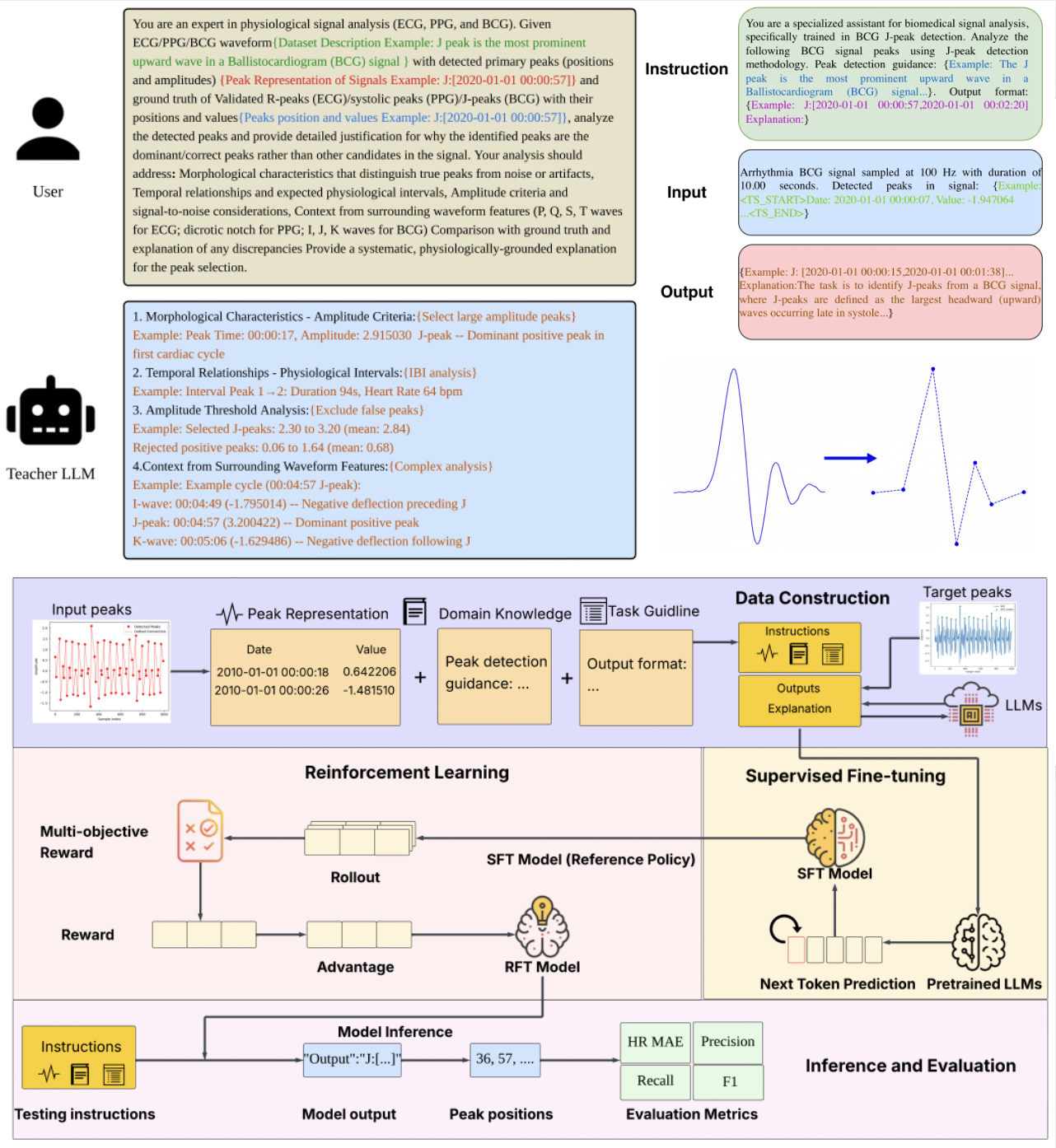
This paper presents Peak-Detector, a unified and explainable framework for peak detection across multiple cardiac physiological signals, including ECG, PPG, BCG, and BSG. It addresses the limitations of traditional single-modality methods and less interpretable deep learning approaches by leveraging instruction-tuned large language models. The key idea is a compact peak representation that preserves critical physiological events while reducing signal complexity, enabling the model to reason more effectively. Trained with supervised fine-tuning and reinforcement learning, and enhanced with a custom explanation dataset, the framework achieves strong and consistent performance across seven datasets. The paper shows that Peak-Detector offers a generalizable, accurate, and interpretable solution for cross-modal peak detection and can also support human-in-the-loop analysis through its generated explanations.
Peak-Detector: Explainable Peak Detection via Instruction–Tuned Large Language Models in Cardiac Physiological Signal
Jiahui Li, Yida Zhang, Zixuan Zeng, Jiayu Chen, Yingjian Song, Yin Xiao, Nishan Dong, Junjie Lu, Younghoon Kwon, Xiang Zhang, Jin Lu, WenZhan Song, Fei Dou# (# corresponding author)
Proceedings of the ACM on Interactive, Mobile, Wearable and Ubiquitous Technologies (UbiComp/IMWUT, CSRankings) 2026
This paper presents Peak-Detector, a unified and explainable framework for peak detection across multiple cardiac physiological signals, including ECG, PPG, BCG, and BSG. It addresses the limitations of traditional single-modality methods and less interpretable deep learning approaches by leveraging instruction-tuned large language models. The key idea is a compact peak representation that preserves critical physiological events while reducing signal complexity, enabling the model to reason more effectively. Trained with supervised fine-tuning and reinforcement learning, and enhanced with a custom explanation dataset, the framework achieves strong and consistent performance across seven datasets. The paper shows that Peak-Detector offers a generalizable, accurate, and interpretable solution for cross-modal peak detection and can also support human-in-the-loop analysis through its generated explanations.
Contactless Sleep Apnea Detection with Bodyseismography
Yingjian Song*, Jiayu Chen*, Zixuan Zeng, Yida Zhang, Zaid Farooq Pitafi, Deepak Kumar Das, Bradley G. Phillips, Younghoon Kwon, Xiang Zhang, Fei Dou, Wenzhan Song (* equal contribution)
Proceedings of the ACM on Interactive, Mobile, Wearable and Ubiquitous Technologies (UbiComp/IMWUT, CSRankings) 2026
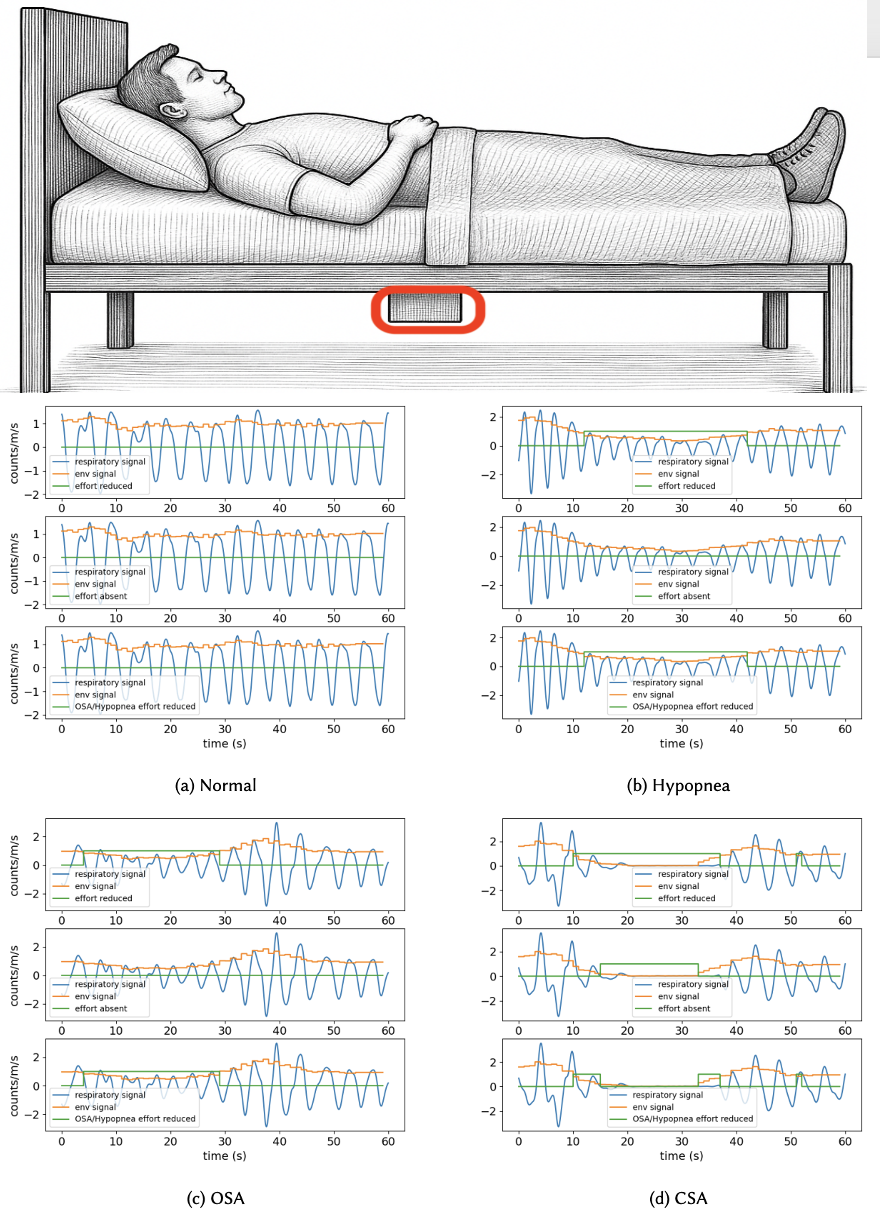
This paper presents a feasibility study of contactless, engagement-free sleep apnea screening using an under-bed horizontal seismic sensor. It shows that the horizontal sensing axis captures respiratory activity more clearly than the vertical axis, making it well suited for respiration-centered analysis. Based on the seismic signal, the method extracts respiratory, heartbeat, and movement features and formulates a minute-level three-class classification task to distinguish Normal, OSA+hypopnea, and CSA. Evaluated on 116 subjects with strict patient-independent 5-fold cross-validation, the approach achieves strong performance, demonstrating that under-bed seismic sensing is a promising solution for window-level apnea-related state classification.
Contactless Sleep Apnea Detection with Bodyseismography
Yingjian Song*, Jiayu Chen*, Zixuan Zeng, Yida Zhang, Zaid Farooq Pitafi, Deepak Kumar Das, Bradley G. Phillips, Younghoon Kwon, Xiang Zhang, Fei Dou, Wenzhan Song (* equal contribution)
Proceedings of the ACM on Interactive, Mobile, Wearable and Ubiquitous Technologies (UbiComp/IMWUT, CSRankings) 2026
This paper presents a feasibility study of contactless, engagement-free sleep apnea screening using an under-bed horizontal seismic sensor. It shows that the horizontal sensing axis captures respiratory activity more clearly than the vertical axis, making it well suited for respiration-centered analysis. Based on the seismic signal, the method extracts respiratory, heartbeat, and movement features and formulates a minute-level three-class classification task to distinguish Normal, OSA+hypopnea, and CSA. Evaluated on 116 subjects with strict patient-independent 5-fold cross-validation, the approach achieves strong performance, demonstrating that under-bed seismic sensing is a promising solution for window-level apnea-related state classification.
ADLGen: Synthesizing Symbolic, Event-Triggered Sensor Sequences for Human Activity Modeling
Weihang You*, Hanqi Jiang*, Jiahui Li*, Zishuai Liu*, Tianming Liu, Jin Lu, Fei Dou# (* equal contribution, # corresponding author)
Proceedings of the 2026 Conference on Embedded Artificial Intelligence and Sensing Systems (SenSys, CORE A*/CSRankings) 2026
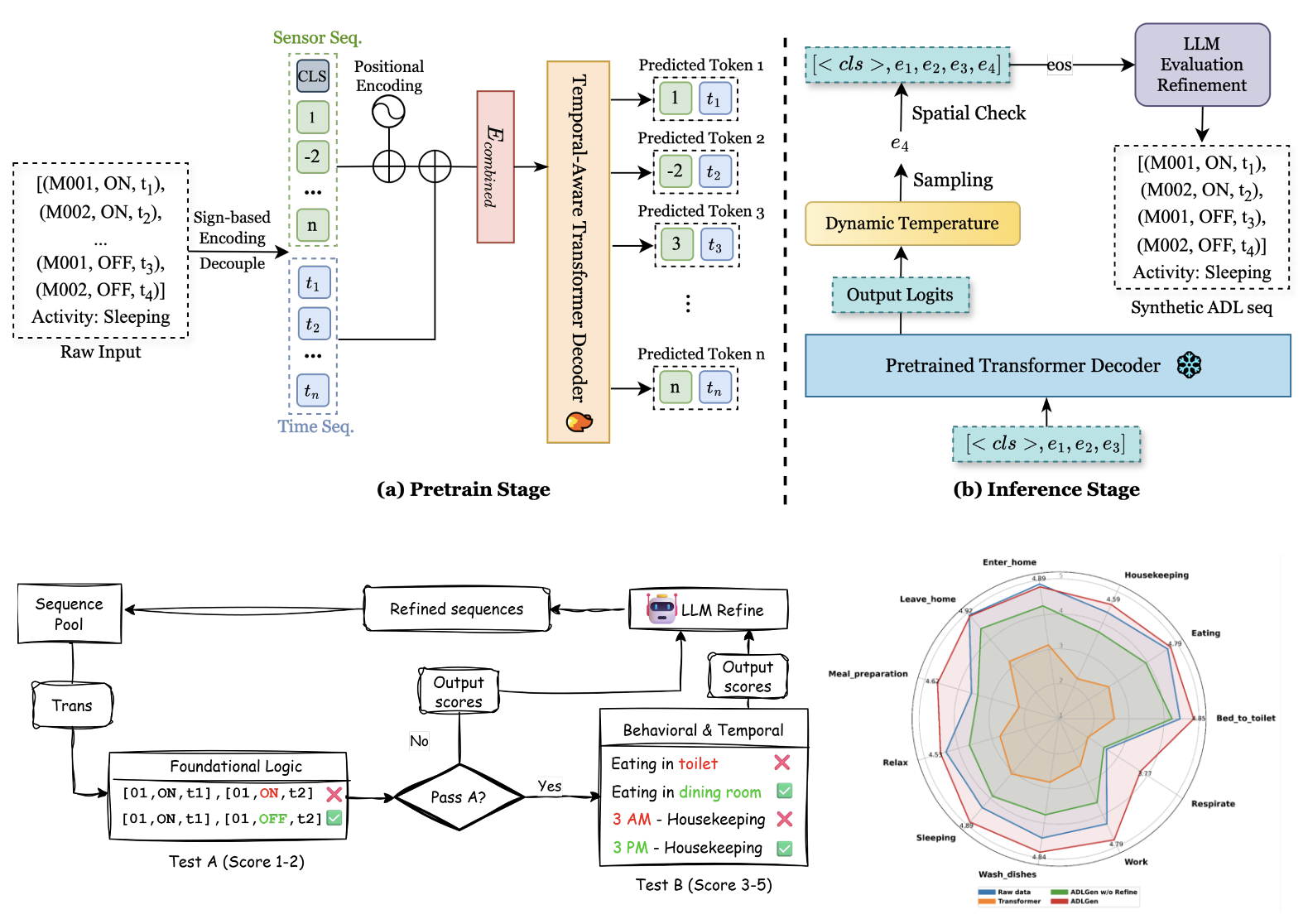
This work introduces ADLGen, a generative framework that synthesizes realistic event-triggered symbolic sensor sequences for ambient assistive environments, addressing the privacy, cost, and sparsity challenges of real-world ADL data collection. ADLGen combines a decoder-only Transformer with sign-based temporal encoding and context-/layout-aware sampling, plus an LLM-driven generate–evaluate–refine loop to enforce logical and temporal coherence without manual tuning. Experiments show ADLGen outperforms baselines in fidelity, semantic richness, and downstream activity recognition.
ADLGen: Synthesizing Symbolic, Event-Triggered Sensor Sequences for Human Activity Modeling
Weihang You*, Hanqi Jiang*, Jiahui Li*, Zishuai Liu*, Tianming Liu, Jin Lu, Fei Dou# (* equal contribution, # corresponding author)
Proceedings of the 2026 Conference on Embedded Artificial Intelligence and Sensing Systems (SenSys, CORE A*/CSRankings) 2026
This work introduces ADLGen, a generative framework that synthesizes realistic event-triggered symbolic sensor sequences for ambient assistive environments, addressing the privacy, cost, and sparsity challenges of real-world ADL data collection. ADLGen combines a decoder-only Transformer with sign-based temporal encoding and context-/layout-aware sampling, plus an LLM-driven generate–evaluate–refine loop to enforce logical and temporal coherence without manual tuning. Experiments show ADLGen outperforms baselines in fidelity, semantic richness, and downstream activity recognition.
Attention Feature Fusion with Cluster Contrastive Learning for Snoring and Breath-Holding Detection Using Seismic Sensing
Yingjian Song*, Jiayu Chen*, Zixuan Zeng, Yida Zhang, Zaid Farooq Pitafi, Xiang Zhang, Fei Dou, Wenzhan Song (* equal contribution)
In 2026 IEEE International Conference on Pervasive Computing and Communications (PerCom, CORE A*) 2026
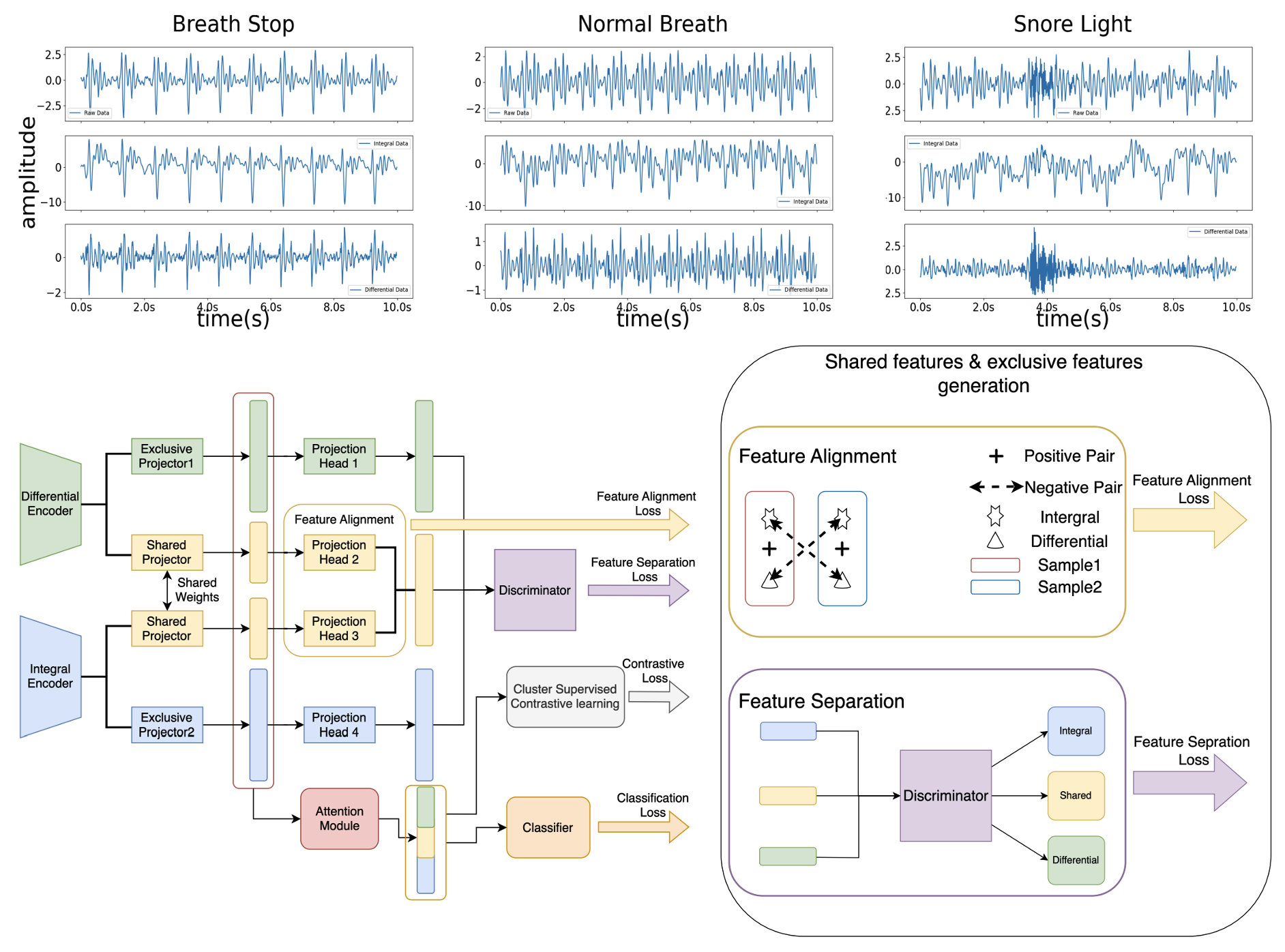
This paper proposes a contactless, engagement-free seismic-sensing system to detect snoring and breath-stopping for sleep apnea, avoiding the discomfort of wearables and the placement sensitivity of smartphone approaches. It introduces Attention Feature Fusion and Cluster Contrastive Learning, which uses differential/integral signal transforms plus attention-based feature fusion and supervised contrastive learning to separate snoring, breath-stopping, and normal breathing.
Attention Feature Fusion with Cluster Contrastive Learning for Snoring and Breath-Holding Detection Using Seismic Sensing
Yingjian Song*, Jiayu Chen*, Zixuan Zeng, Yida Zhang, Zaid Farooq Pitafi, Xiang Zhang, Fei Dou, Wenzhan Song (* equal contribution)
In 2026 IEEE International Conference on Pervasive Computing and Communications (PerCom, CORE A*) 2026
This paper proposes a contactless, engagement-free seismic-sensing system to detect snoring and breath-stopping for sleep apnea, avoiding the discomfort of wearables and the placement sensitivity of smartphone approaches. It introduces Attention Feature Fusion and Cluster Contrastive Learning, which uses differential/integral signal transforms plus attention-based feature fusion and supervised contrastive learning to separate snoring, breath-stopping, and normal breathing.
CARE: Contrastive Alignment for ADL Recognition from Event-Triggered Sensor Streams
Junhao Zhao, Zishuai Liu, Ruili Fang, Jin Lu, Linghan Zhang, Fei Dou# (# corresponding author)
In 2026 IEEE International Conference on Pervasive Computing and Communications (PerCom, CORE A*) 2026
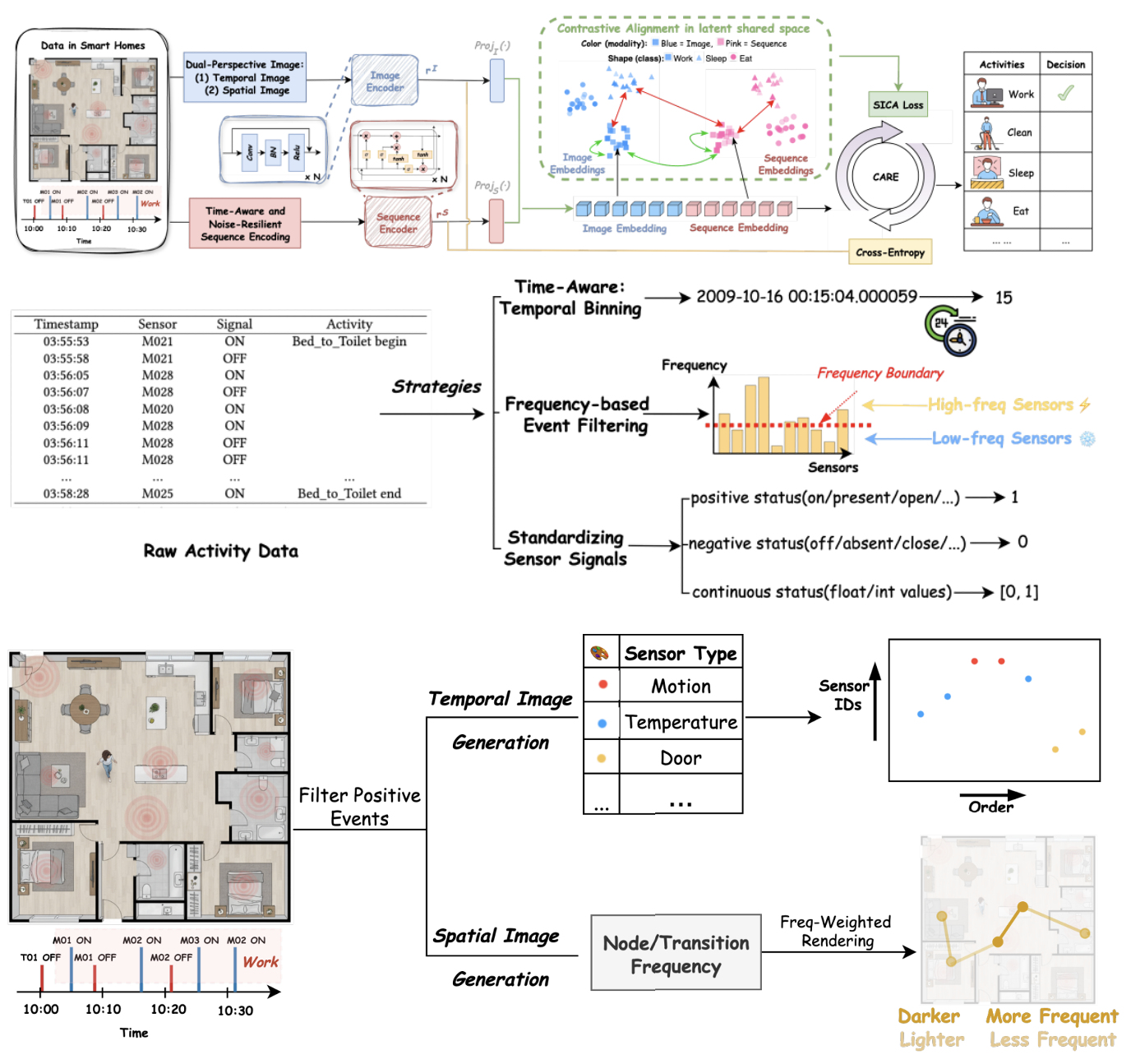
This paper presents CARE, an end-to-end framework for recognizing ADLs from event-triggered ambient sensors by aligning complementary sequence and image representations. Unlike sequence-only methods that lack spatial awareness and are noise-sensitive, or image-only methods that blur temporal dynamics and distort layouts, CARE enforces Sequence-Image Contrastive Alignment (SICA) while jointly optimizing classification with a contrastive-plus-cross-entropy objective. By combining time-aware, noise-resilient sequence encoding with spatially informed, frequency-sensitive image features, CARE learns aligned and discriminative embeddings.
CARE: Contrastive Alignment for ADL Recognition from Event-Triggered Sensor Streams
Junhao Zhao, Zishuai Liu, Ruili Fang, Jin Lu, Linghan Zhang, Fei Dou# (# corresponding author)
In 2026 IEEE International Conference on Pervasive Computing and Communications (PerCom, CORE A*) 2026
This paper presents CARE, an end-to-end framework for recognizing ADLs from event-triggered ambient sensors by aligning complementary sequence and image representations. Unlike sequence-only methods that lack spatial awareness and are noise-sensitive, or image-only methods that blur temporal dynamics and distort layouts, CARE enforces Sequence-Image Contrastive Alignment (SICA) while jointly optimizing classification with a contrastive-plus-cross-entropy objective. By combining time-aware, noise-resilient sequence encoding with spatially informed, frequency-sensitive image features, CARE learns aligned and discriminative embeddings.
HELENE: Hessian Layer-wise Clipping and Gradient Annealing for Accelerating Fine-tuning LLM with Zeroth-order Optimization
Huaqin Zhao*, Jiaxi Li*, Yi Pan, Shizhe Liang, Xiaofeng Yang, Wei Liu, Xiang Li, Fei Dou, Tianming Liu, Jin Lu (* equal contribution)
Proceedings of the 2025 Conference on Empirical Methods in Natural Language Processing (EMNLP, CORE A*/CSRankings) 2025
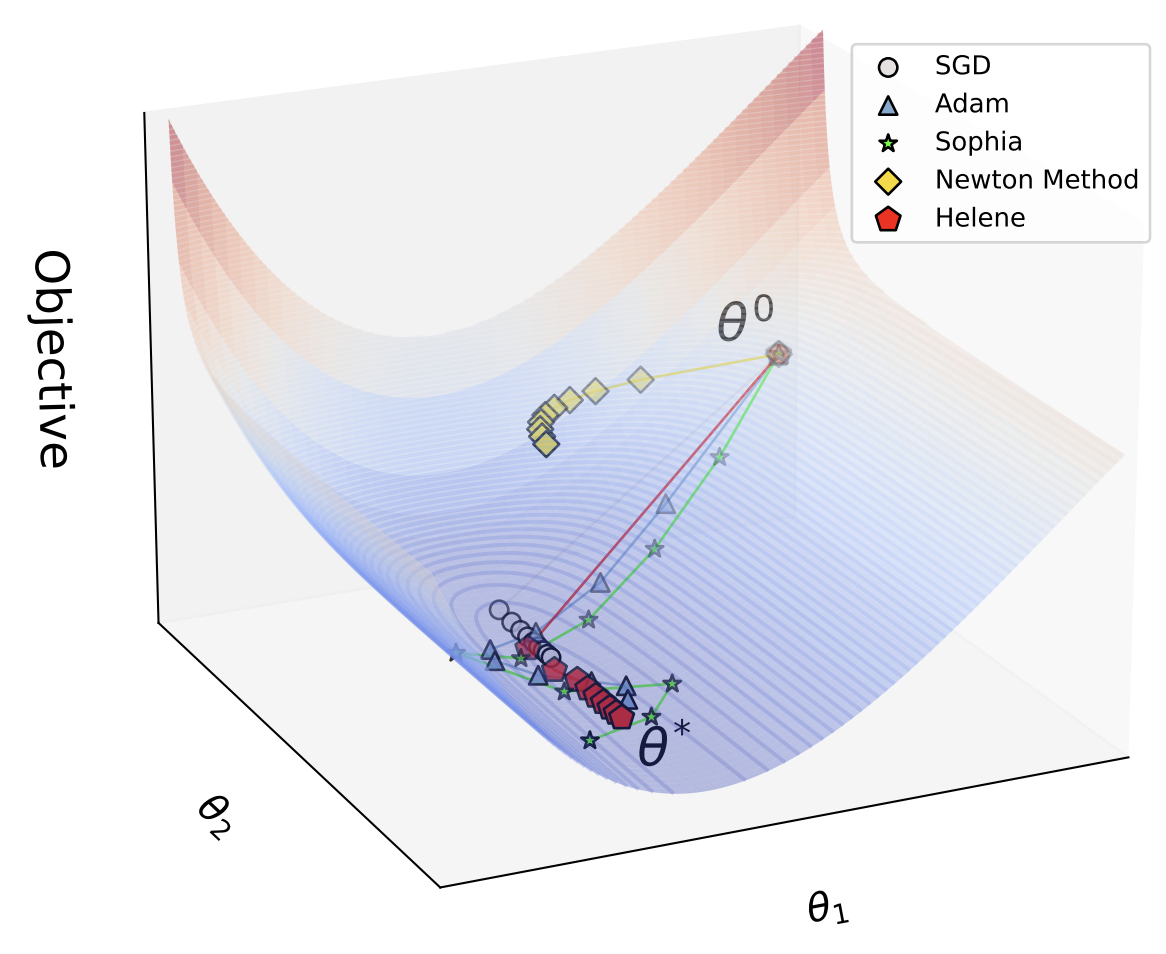
This paper presents HELENE, a memory-efficient and scalable optimizer for fine-tuning large language models, addressing the slow convergence of zeroth-order methods like MeZO by incorporating annealed A-GNB gradients, diagonal Hessian estimation, and layer-wise clipping. HELENE achieves faster, more stable convergence with up to 20× speedup and improved accuracy, and it supports both full and parameter-efficient fine-tuning across large-scale models and tasks.
HELENE: Hessian Layer-wise Clipping and Gradient Annealing for Accelerating Fine-tuning LLM with Zeroth-order Optimization
Huaqin Zhao*, Jiaxi Li*, Yi Pan, Shizhe Liang, Xiaofeng Yang, Wei Liu, Xiang Li, Fei Dou, Tianming Liu, Jin Lu (* equal contribution)
Proceedings of the 2025 Conference on Empirical Methods in Natural Language Processing (EMNLP, CORE A*/CSRankings) 2025
This paper presents HELENE, a memory-efficient and scalable optimizer for fine-tuning large language models, addressing the slow convergence of zeroth-order methods like MeZO by incorporating annealed A-GNB gradients, diagonal Hessian estimation, and layer-wise clipping. HELENE achieves faster, more stable convergence with up to 20× speedup and improved accuracy, and it supports both full and parameter-efficient fine-tuning across large-scale models and tasks.
LOCAL: Latent Orthonormal Contrastive Learning for Paired Images
Fei Dou, Jin Lu, Tan Zhu, Jinbo Bi
Proceedings of the IEEE/CVF International Conference on Computer Vision (ICCV Findings, Oral) 2025
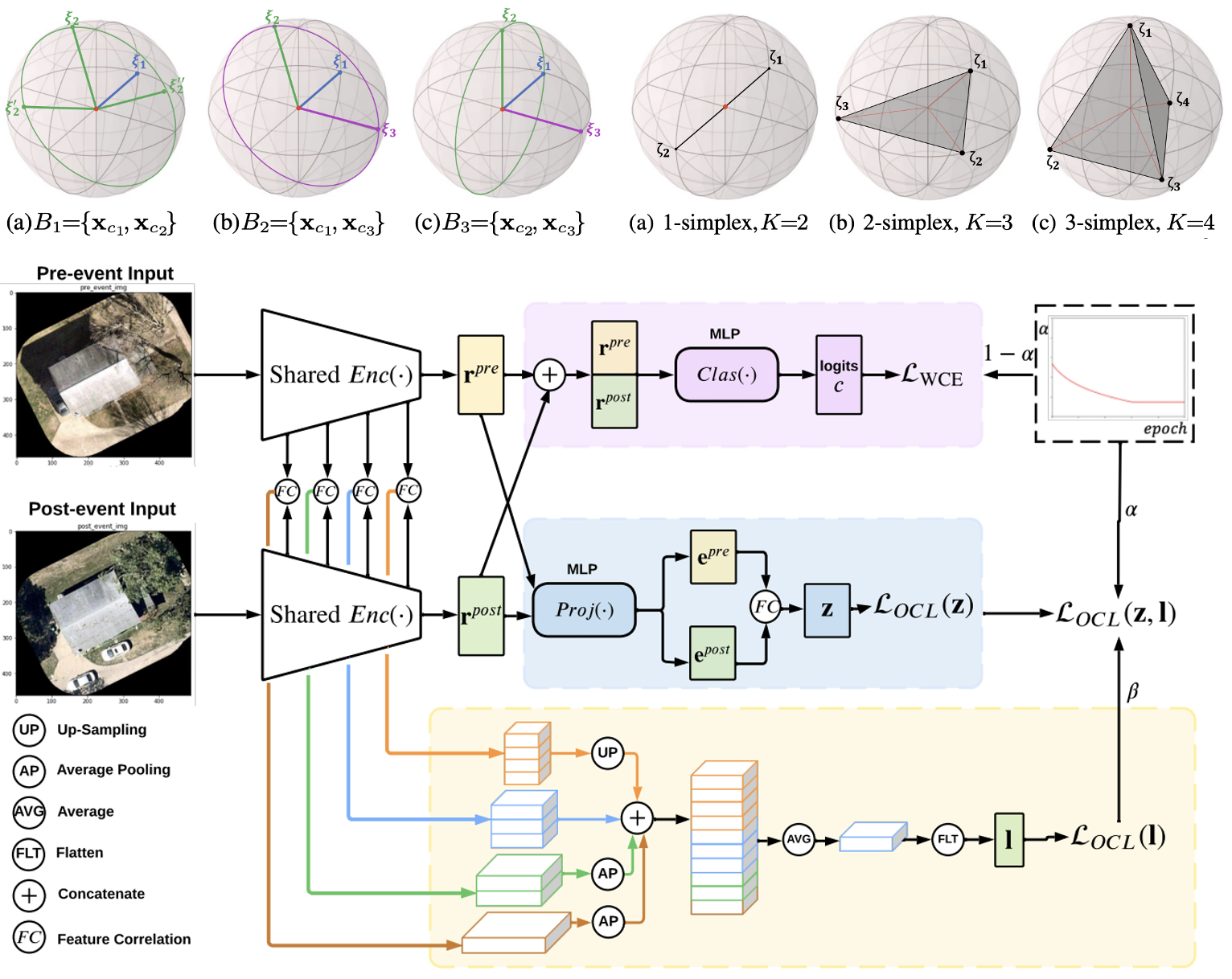
This paper introduces Latent Orthonormal Contrastive Learning (LOCAL), a method for paired image classification that addresses limitations of Supervised Contrastive Learning (SCL) under small batch sizes and class imbalance. By mapping class representations to orthogonal planes and incorporating a feature correlation module, LOCAL improves efficiency and discriminative power, achieving superior performance on high-resolution, paired satellite image tasks.
LOCAL: Latent Orthonormal Contrastive Learning for Paired Images
Fei Dou, Jin Lu, Tan Zhu, Jinbo Bi
Proceedings of the IEEE/CVF International Conference on Computer Vision (ICCV Findings, Oral) 2025
This paper introduces Latent Orthonormal Contrastive Learning (LOCAL), a method for paired image classification that addresses limitations of Supervised Contrastive Learning (SCL) under small batch sizes and class imbalance. By mapping class representations to orthogonal planes and incorporating a feature correlation module, LOCAL improves efficiency and discriminative power, achieving superior performance on high-resolution, paired satellite image tasks.
Multi-granularity Supervised Contrastive Learning with Online Adaptation for Contactless In-bed Posture Classification
Yingjian Song, Haotian Xiang, Zixuan Zeng, Jiayu Chen, Yida Zhang, Zaid Farooq Pitafi, He Yang, Qin Lu, Xiang Zhang, Bradley G Phillips, Fei Dou, WenZhan Song
Proceedings of the ACM on Interactive, Mobile, Wearable and Ubiquitous Technologies (UbiComp/IMWUT, CSRankings) 2025
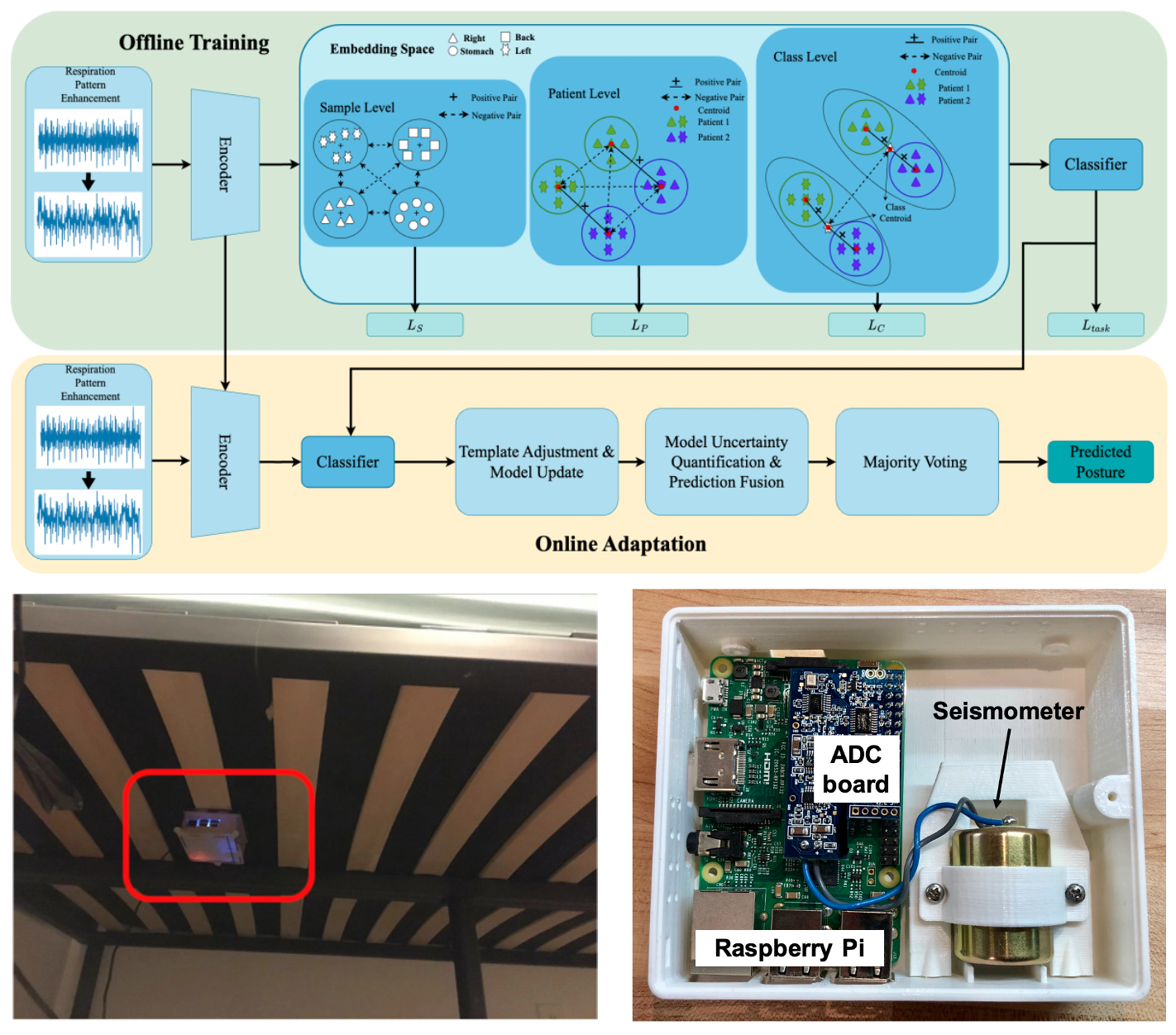
This paper presents a privacy-friendly, easy-to-deploy in-bed posture classification framework using seismic sensors, integrating a Multi-Granularity Supervised Contrastive Learning (MGSCL) module and an ensemble Online Adaptation (OA) module. The system effectively adapts to individual variations and unlabeled data, achieving high accuracy (91.67%) and F1 score (91.53%) with minimal labeled data in clinical settings, and maintaining strong performance in home environments, highlighting its potential for sleep quality and health monitoring.
Multi-granularity Supervised Contrastive Learning with Online Adaptation for Contactless In-bed Posture Classification
Yingjian Song, Haotian Xiang, Zixuan Zeng, Jiayu Chen, Yida Zhang, Zaid Farooq Pitafi, He Yang, Qin Lu, Xiang Zhang, Bradley G Phillips, Fei Dou, WenZhan Song
Proceedings of the ACM on Interactive, Mobile, Wearable and Ubiquitous Technologies (UbiComp/IMWUT, CSRankings) 2025
This paper presents a privacy-friendly, easy-to-deploy in-bed posture classification framework using seismic sensors, integrating a Multi-Granularity Supervised Contrastive Learning (MGSCL) module and an ensemble Online Adaptation (OA) module. The system effectively adapts to individual variations and unlabeled data, achieving high accuracy (91.67%) and F1 score (91.53%) with minimal labeled data in clinical settings, and maintaining strong performance in home environments, highlighting its potential for sleep quality and health monitoring.
Self-Supervised Representation Learning and Temporal-Spectral Feature Fusion for Bed Occupancy Detection
Yingjian Song, Zaid Farooq Pitafi, Fei Dou, Jin Sun, Xiang Zhang, Bradley G Phillips, WenZhan Song
Proceedings of the ACM on Interactive, Mobile, Wearable and Ubiquitous Technologies (UbiComp/IMWUT, CSRankings) 2024
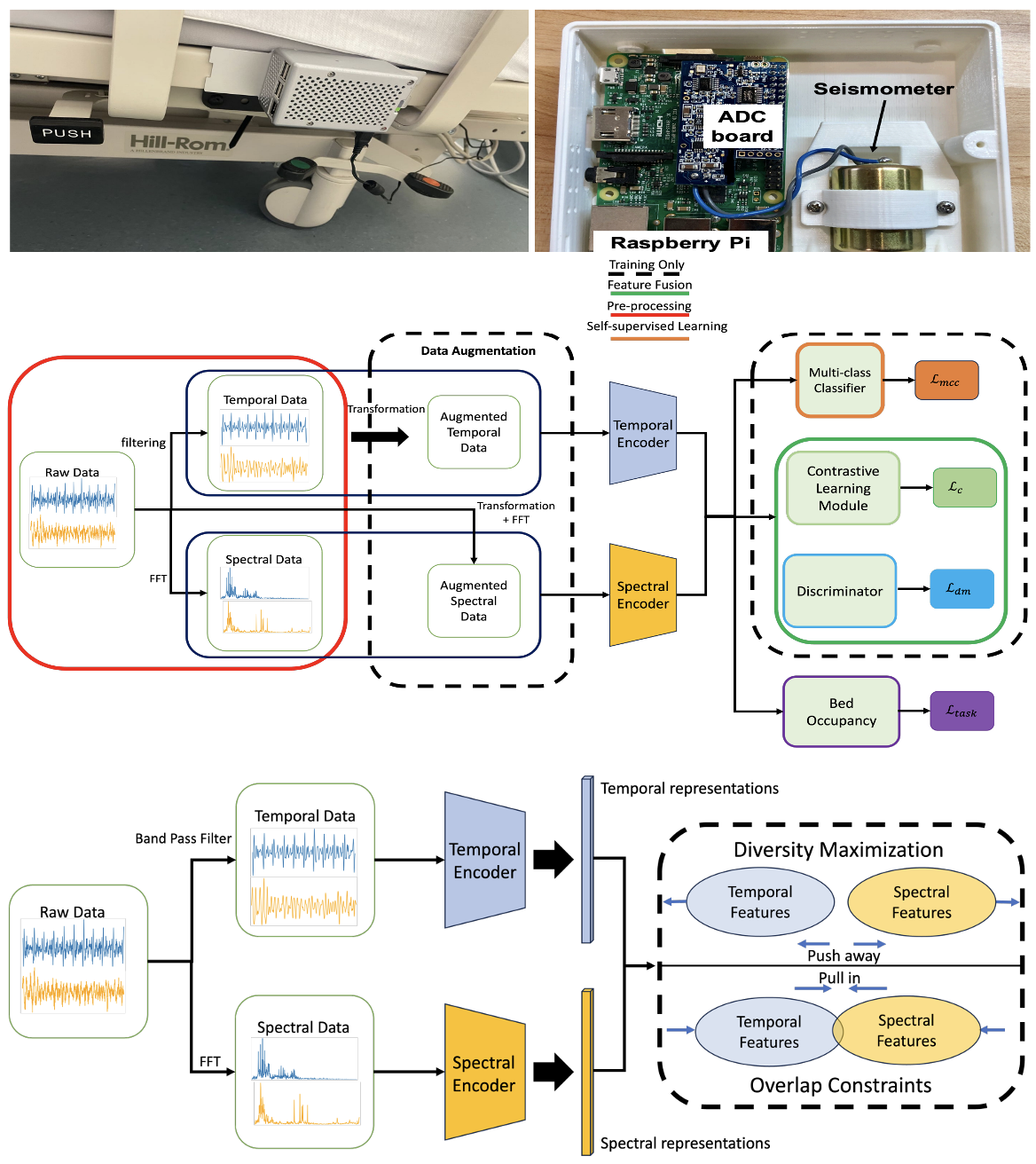
This paper presents SeismoDot, a bed occupancy detection system that combines self-supervised learning and spectral-temporal feature fusion to improve generalization across diverse environments with limited data. Unlike traditional threshold-based methods, SeismoDot achieves high accuracy and F1 scores across 13 settings and remains effective even when trained on only 20% of the data, demonstrating strong adaptability and efficiency.
Self-Supervised Representation Learning and Temporal-Spectral Feature Fusion for Bed Occupancy Detection
Yingjian Song, Zaid Farooq Pitafi, Fei Dou, Jin Sun, Xiang Zhang, Bradley G Phillips, WenZhan Song
Proceedings of the ACM on Interactive, Mobile, Wearable and Ubiquitous Technologies (UbiComp/IMWUT, CSRankings) 2024
This paper presents SeismoDot, a bed occupancy detection system that combines self-supervised learning and spectral-temporal feature fusion to improve generalization across diverse environments with limited data. Unlike traditional threshold-based methods, SeismoDot achieves high accuracy and F1 scores across 13 settings and remains effective even when trained on only 20% of the data, demonstrating strong adaptability and efficiency.
Mobilizing Personalized Federated Learning in Infrastructure-Less and Heterogeneous Environments via Random Walk Stochastic ADMM
Ziba Parsons, Fei Dou, Houyi Du, Zheng Song, Jin Lu
Advances in Neural Information Processing Systems 37 (NeurIPS, CORE A*/CSRankings) 2023
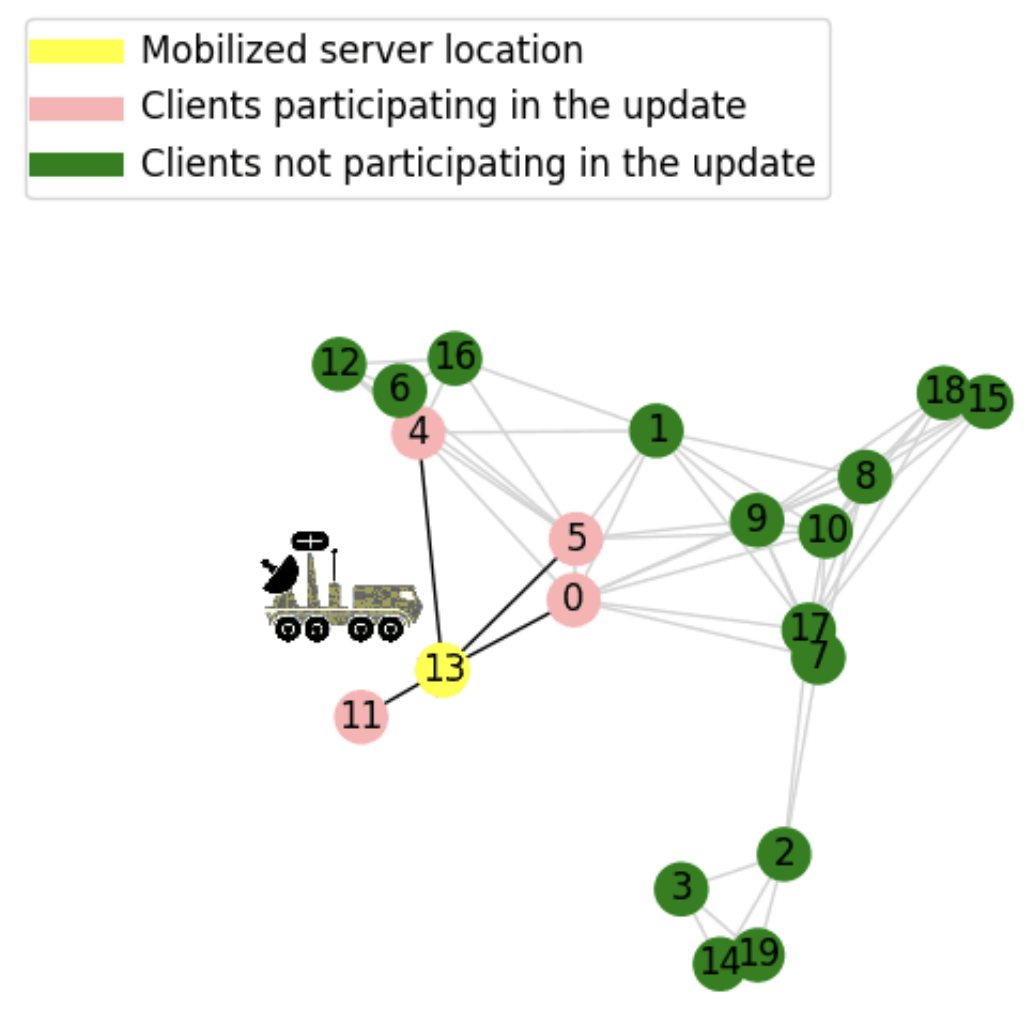
This paper proposes RWSADMM, a novel federated learning algorithm designed for infrastructure-less environments with isolated, heterogeneous nodes connected via wireless links. By leveraging server mobility and enforcing hard constraints among adjacent clients, RWSADMM enables efficient, personalized learning with provable convergence, reduced communication costs, and improved accuracy and scalability over baseline methods.
Mobilizing Personalized Federated Learning in Infrastructure-Less and Heterogeneous Environments via Random Walk Stochastic ADMM
Ziba Parsons, Fei Dou, Houyi Du, Zheng Song, Jin Lu
Advances in Neural Information Processing Systems 37 (NeurIPS, CORE A*/CSRankings) 2023
This paper proposes RWSADMM, a novel federated learning algorithm designed for infrastructure-less environments with isolated, heterogeneous nodes connected via wireless links. By leveraging server mobility and enforcing hard constraints among adjacent clients, RWSADMM enables efficient, personalized learning with provable convergence, reduced communication costs, and improved accuracy and scalability over baseline methods.
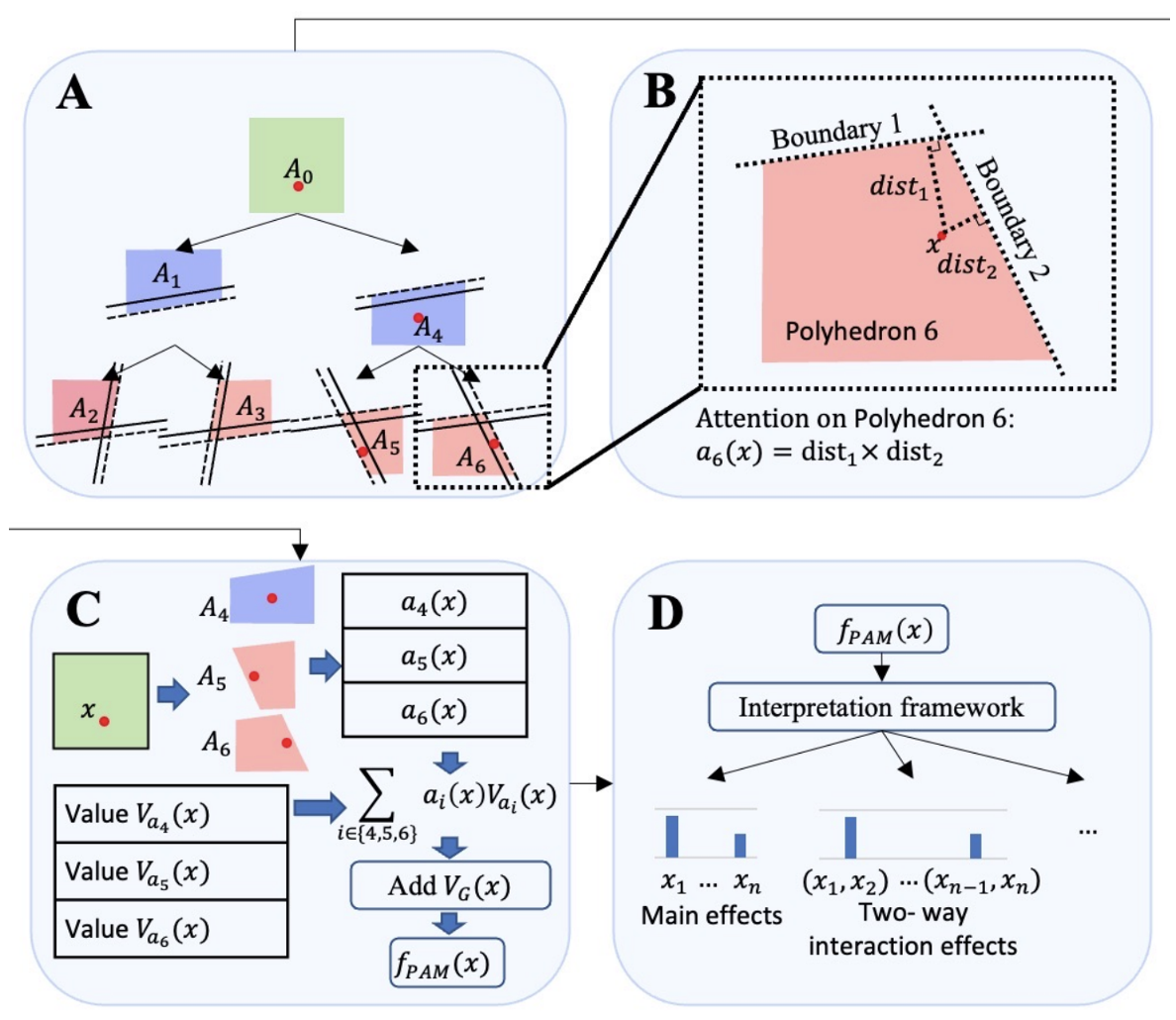
Polyhedron Attention Module: Learning Adaptive-order Interactions
Tan Zhu, Fei Dou, Xinyu Wang, Jin Lu, Jinbo Bi
Advances in Neural Information Processing Systems 37 (NeurIPS, CORE A*/CSRankings) 2023
This paper introduces the Polyhedron Attention Module (PAM), which forms interpretable, piecewise polynomial models by adaptively learning feature interactions within polyhedrons in the input space. PAM outperforms ReLU-based networks in expressive power and achieves superior classification results on large-scale click-through rate datasets while uncovering meaningful interactions in medical applications.
Polyhedron Attention Module: Learning Adaptive-order Interactions
Tan Zhu, Fei Dou, Xinyu Wang, Jin Lu, Jinbo Bi
Advances in Neural Information Processing Systems 37 (NeurIPS, CORE A*/CSRankings) 2023
This paper introduces the Polyhedron Attention Module (PAM), which forms interpretable, piecewise polynomial models by adaptively learning feature interactions within polyhedrons in the input space. PAM outperforms ReLU-based networks in expressive power and achieves superior classification results on large-scale click-through rate datasets while uncovering meaningful interactions in medical applications.
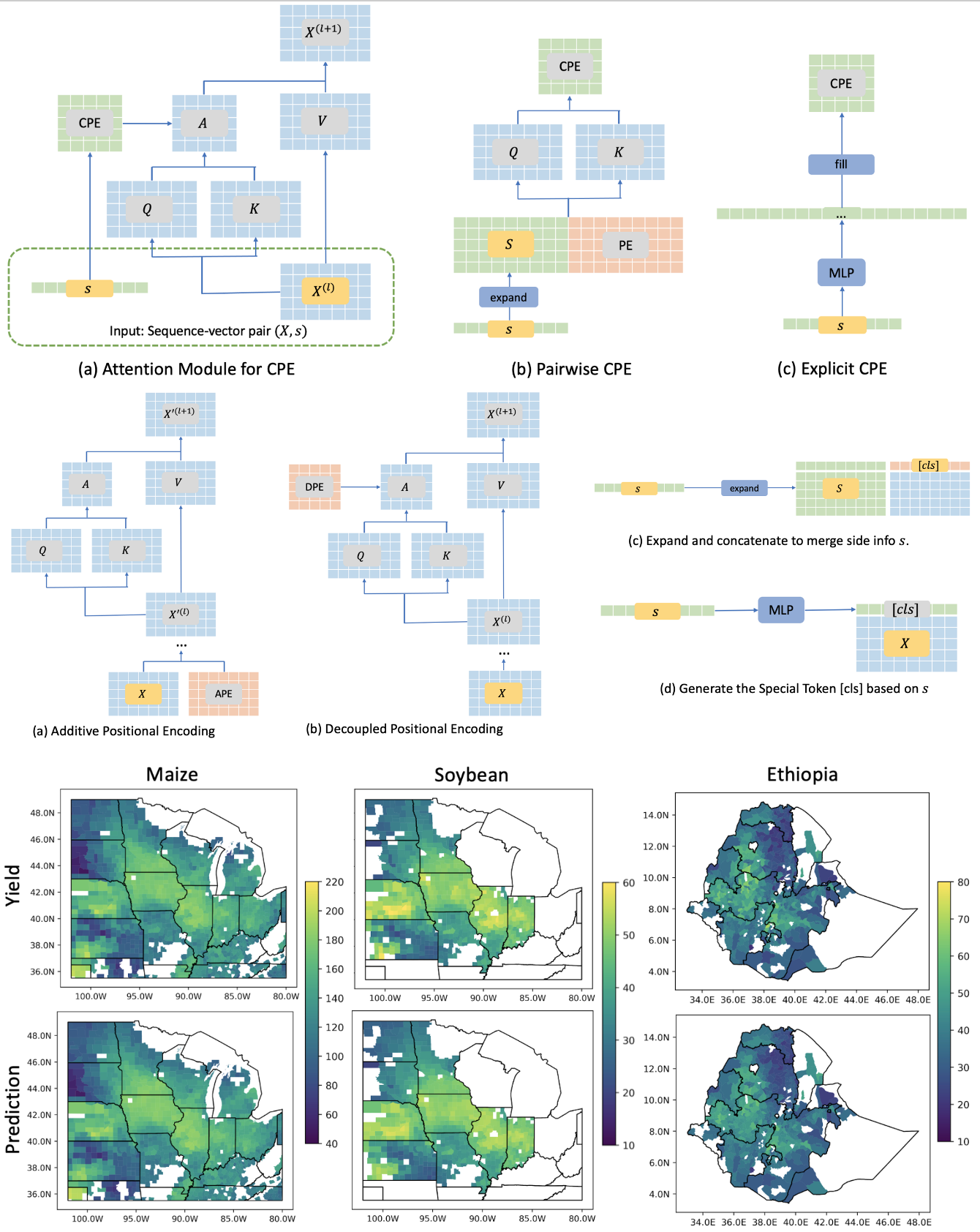
Customized Positional Encoding to Combine Static and Time-varying Data in Robust Representation Learning for Crop Yield Prediction
Qinqing Liu, Fei Dou, Meijian Yang, Ezana Amdework, Guiling Wang, Jinbo Bi
the International Joint Conference on Artificial Intelligence (IJCAI, CORE A*/CSRankings) 2023
This paper introduces a novel Transformer-based architecture for crop yield prediction that incorporates Customized Positional Encoding (CPE), adapting sequence encoding based on static variables like geographic location. By leveraging CPE and partially linearized attention, the model significantly improves prediction robustness under climate variability, reducing mean absolute error by up to 26% compared to baseline models during extreme drought years.
Customized Positional Encoding to Combine Static and Time-varying Data in Robust Representation Learning for Crop Yield Prediction
Qinqing Liu, Fei Dou, Meijian Yang, Ezana Amdework, Guiling Wang, Jinbo Bi
the International Joint Conference on Artificial Intelligence (IJCAI, CORE A*/CSRankings) 2023
This paper introduces a novel Transformer-based architecture for crop yield prediction that incorporates Customized Positional Encoding (CPE), adapting sequence encoding based on static variables like geographic location. By leveraging CPE and partially linearized attention, the model significantly improves prediction robustness under climate variability, reducing mean absolute error by up to 26% compared to baseline models during extreme drought years.
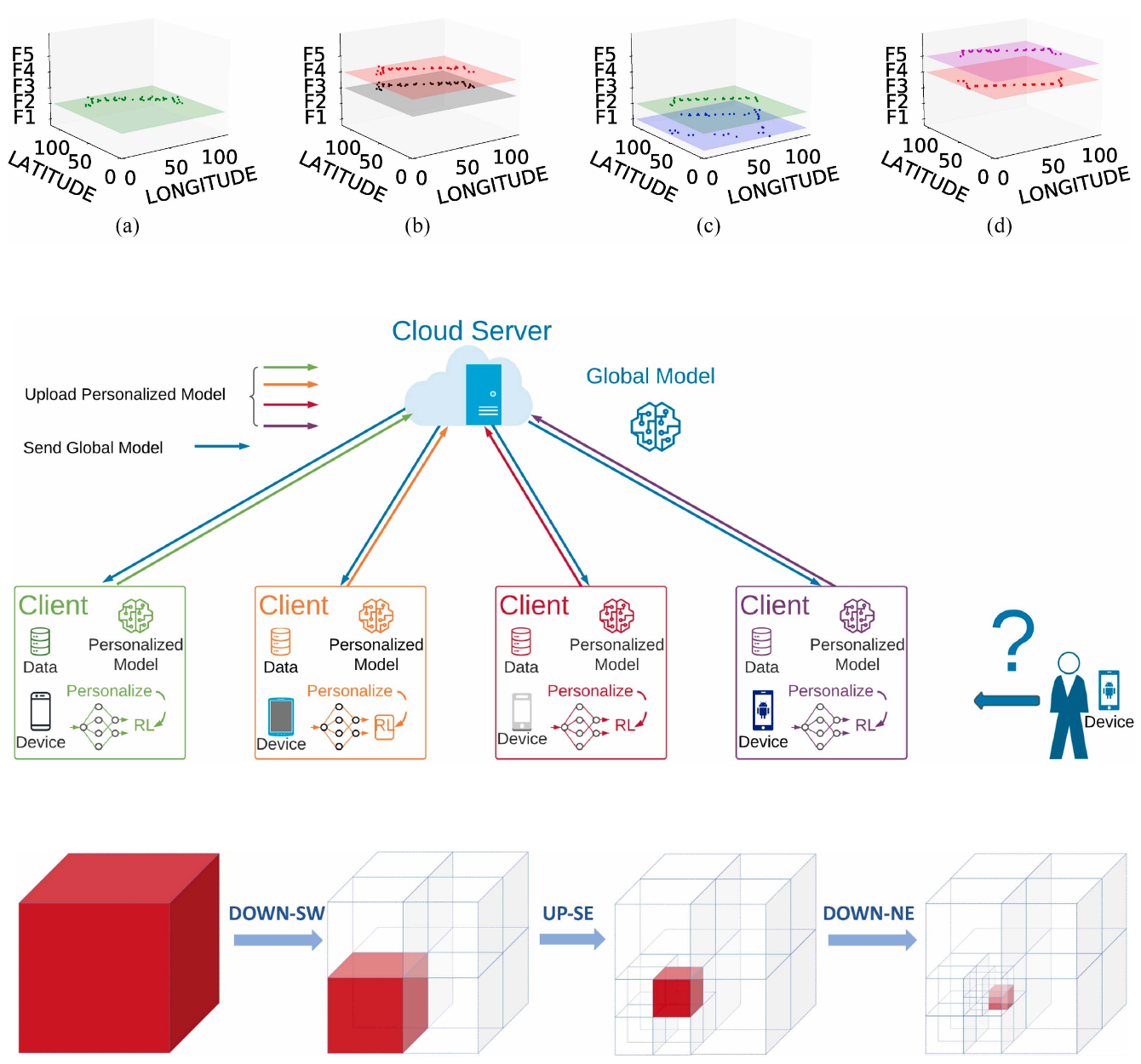
On-Device Indoor Positioning: A Federated Reinforcement Learning Approach With Heterogeneous Devices
Fei Dou, Jin Lu, Tan Zhu, Jinbo Bi
IEEE Internet of Things Journal (IOT-J, IF=10.6) 2023
This paper proposes a personalized federated reinforcement learning (RL) framework for indoor localization that enables mobile devices to train locally while preserving data privacy and coping with limited connectivity and data heterogeneity. By combining personalized on-device RL with a global model trained via sparse updates, the approach achieves improved localization accuracy and robustness, and is further extended to support few-shot learning for rapid adaptation to new users with minimal data.
On-Device Indoor Positioning: A Federated Reinforcement Learning Approach With Heterogeneous Devices
Fei Dou, Jin Lu, Tan Zhu, Jinbo Bi
IEEE Internet of Things Journal (IOT-J, IF=10.6) 2023
This paper proposes a personalized federated reinforcement learning (RL) framework for indoor localization that enables mobile devices to train locally while preserving data privacy and coping with limited connectivity and data heterogeneity. By combining personalized on-device RL with a global model trained via sparse updates, the approach achieves improved localization accuracy and robustness, and is further extended to support few-shot learning for rapid adaptation to new users with minimal data.
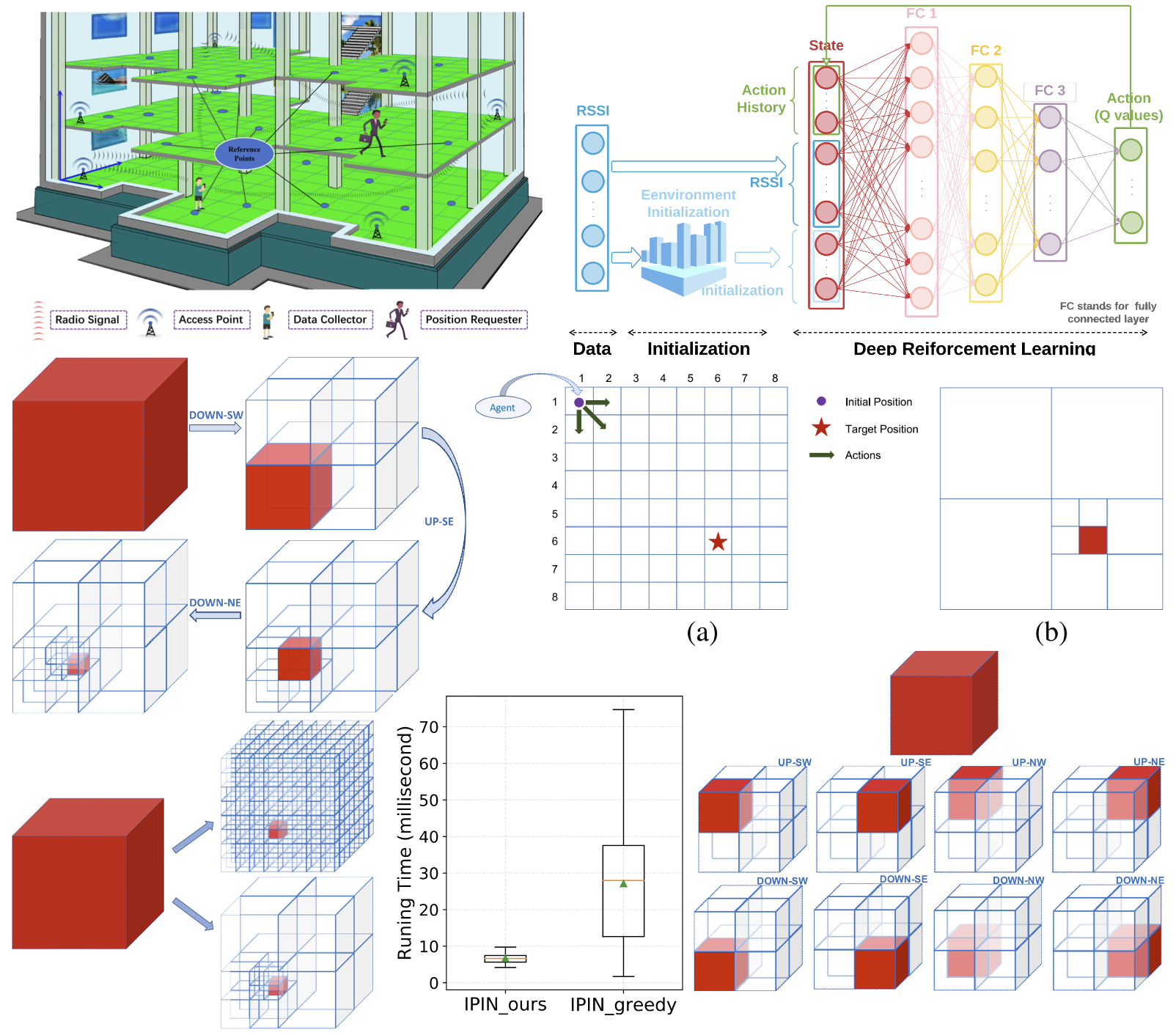
A Bisection Reinforcement Learning Approach to 3D Indoor Localization
Fei Dou, Jin Lu, Tingyang Xu, Chun-Hsi Huang, Jinbo Bi
IEEE Internet of Things Journal (IOT-J, IF=10.6) 2021
This article presents a deep reinforcement learning-based approach to 3-D indoor localization using Wi-Fi RSSI fingerprinting, addressing signal variability and environmental dynamics. By formulating localization as a Markov decision process and hierarchically bisecting the search space, the method achieves high accuracy and robustness while reducing time complexity from O(N3) to O(log N), outperforming traditional sequential localization methods.
A Bisection Reinforcement Learning Approach to 3D Indoor Localization
Fei Dou, Jin Lu, Tingyang Xu, Chun-Hsi Huang, Jinbo Bi
IEEE Internet of Things Journal (IOT-J, IF=10.6) 2021
This article presents a deep reinforcement learning-based approach to 3-D indoor localization using Wi-Fi RSSI fingerprinting, addressing signal variability and environmental dynamics. By formulating localization as a Markov decision process and hierarchically bisecting the search space, the method achieves high accuracy and robustness while reducing time complexity from O(N3) to O(log N), outperforming traditional sequential localization methods.
All publications
Visitor Map